Insights
How To Unify Customer Data Across Your Organization.

Quick access:
- What Is Fragmented Customer Data?
- Why Is Scattered Customer Data A Business Problem?
- What Does It Mean To Unify Customer Data?
- Unify Customer Data In 6 steps
- The Benefits Of Unified Customer Data
In many organizations, customer information is often spread across CRM, ERP, e-commerce, marketing, customer service and other systems. Each application may contain valuable information, but when these sources are disconnected, organizations end up with duplicate records, inconsistent information and an incomplete view of the customer.
This fragmented customer data makes it difficult to answer a seemingly simple question: Who is this customer, and what do we actually know about them?
Unifying customer data helps organizations connect these fragmented records, establish trusted customer identities and create a shared understanding of the customer across the organization. It enables the creation of a 360-degree customer view.
What Is Fragmented Customer Data?
Fragmented customer data is customer information that is distributed across multiple systems, departments or databases without a consistent way to connect it into a complete view of the customer.
For example, one system may identify a customer by their email address, while another uses a customer ID and a third links their purchases to a different account number. These records may all refer to the same customer, but without a reliable way to connect them, the organization may treat them as separate entities.
The result is scattered customer data and an incomplete understanding of the customer.
Webinar: watch on-demand
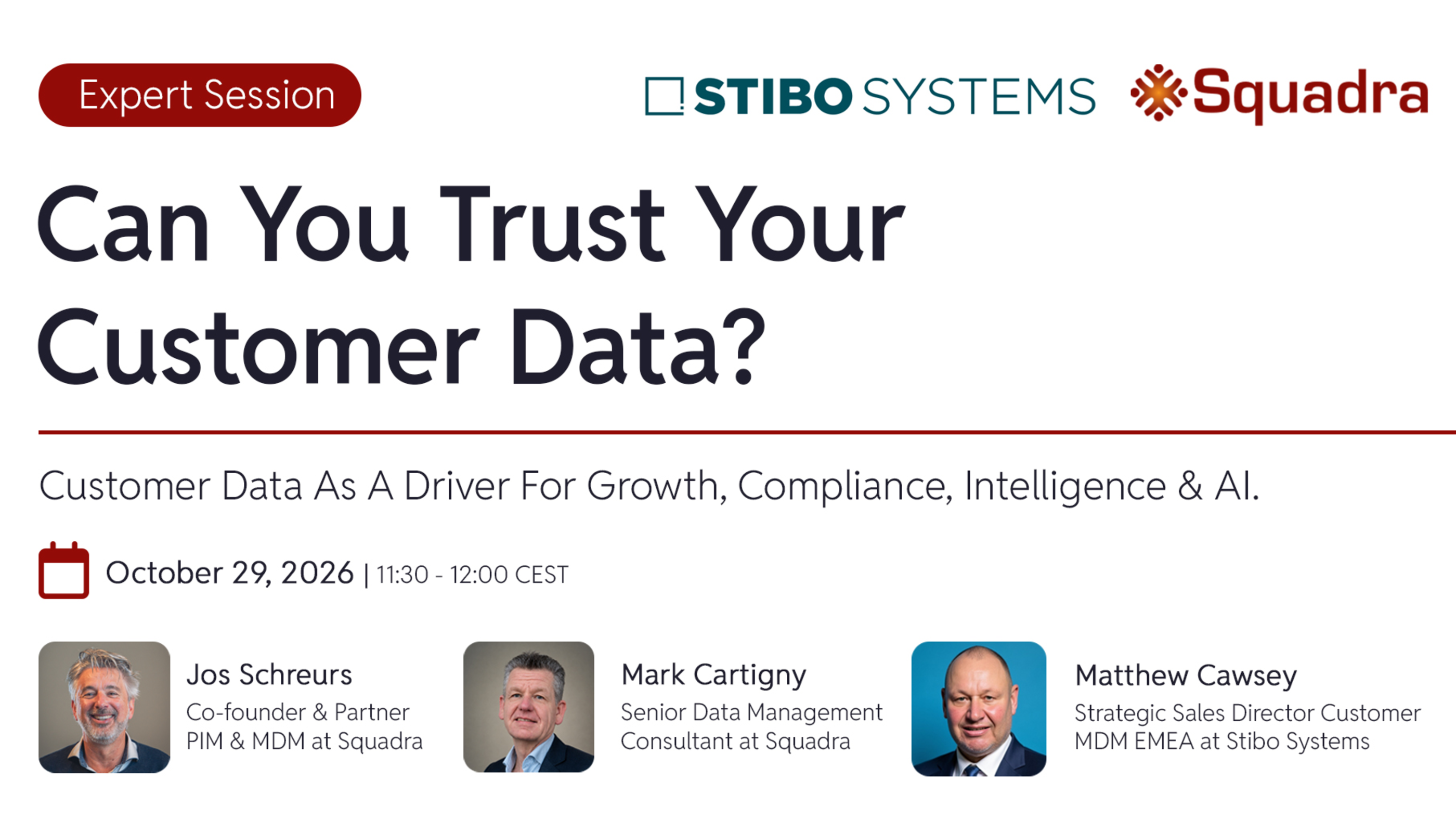
Customer Data As A Driver For Growth, Compliance, Intelligence And AI.
During this Expert Session, Jos Schreurs, Mark Cartigny and Matthew Cawsey will explore why Customer MDM is becoming an essential foundation for growth, compliance, intelligence and AI. In 30 minutes, you’ll learn more about how to build trusted customer data, overcome common data challenges, and turn better customer data into tangible business value.
Why Is Scattered Customer Data A Business Problem?
Customer data fragmentation is not simply a data quality issue. It can directly affect business processes and decision-making. It can lead to incomplete customer understanding because different departments may see different parts of the customer relationship.
Cross- and upsell opportunities can be missed when organizations cannot recognize which products or services a customer already uses. Inconsistent customer experiences arise when customers are confronted with a collection of different departments instead of one unified organization. Duplicate or incomplete customer records can also distort customer counts, segmentation and customer lifetime value calculations.
On top of that: fragmented and inconsistent data can affect the reliability of AI applications. They depend heavily on the quality and context of the data they receive. When relevant information is missing, outdated or inconsistent, AI-generated insights and outputs may be less accurate, relevant or reliable.
What Does It Mean To Unify Customer Data?
Unifying customer data means creating a consistent and connected view of the customer across the organization. Customer information can remain in different systems, such as CRM, ERP, e-commerce and customer service platforms. The important part is that these systems can reliably connect the information they hold about the same customer.
This starts with establishing a trusted customer identity. Instead of treating every record as a separate entity, organizations can determine which records belong to the same customer and connect the relevant information. This can include contact details, purchases, accounts, interactions and other information related to the customer.
The goal of unifying customer data is not necessarily to move all customer data into one central database or replace existing systems, but to create a shared understanding of the customer across those systems. When customer information can reliably be connected and trusted, different departments can work with a more complete picture of the customer while continuing to use the systems they rely on every day.
To unify customer data means to transform scattered information into a connected customer view that can support processes across sales, marketing, customer service and other departments and applications.
The Role Of Customer Data Management.
Customer data management encompasses the processes, technology and governance required to collect, connect, maintain and distribute trusted customer information.
An effective customer data management approach typically includes:
- Identity resolution: Determining which records across different systems represent the same real-world person or organization.
- Data quality: Standardizing, validating and improving customer information.
- Golden record creation: Determining which information should be considered authoritative when different systems contain conflicting information.
- Relationship management: Connecting customers to households, organizations, accounts, products, contracts and other relevant entities.
- Data governance: Defining ownership, responsibilities and rules for managing customer data.
- Data distribution: Making trusted customer information available to the systems, applications and business processes that need it.
Together, these capabilities turn customer data management from simple data cleansing into an enterprise-wide customer data capability.
How Customer MDM Unifies Customer Data In 6 Steps.
A lot of organizations still struggle with their customer data. Customer Master Data Management (Customer MDM) provides a governed way to establish trusted customer identities across systems.
- Connect customer data sources: Identify the systems that contain relevant customer information, such as CRM, ERP, e-commerce, marketing and customer service platforms.
- Resolve customer identities: determine which records represent the same customer based on relevant attributes and matching rules.
- Improve data quality: standardize and validate customer information so that records can be compared and used consistently.
- Create a golden record: combine trusted information into a mastered representation of the customer.
- Connect customer relationships: go beyond individual records by connecting people, companies, households, accounts, subsidiaries, products and contracts.
- Make trusted data available: distribute the mastered customer information to the applications and processes that depend on it.
This process creates a shared customer identity across the organization, rather than another isolated customer database.
Customer MDM Is More Than Deduplication.
Customer MDM is often treated as an advanced form of deduplication. However, identifying duplicates is only one part of the challenge. Where deduplication is simply asking is two records are duplicate, Customer MDM focusses on finding out which records represent the same customer, what relationships exist, who owns the data, which information is trusted and where to use it.
What Are The Benefits Of Unified Customer Data?
Once fragmented customer data is connected, new opportunities across a range of business processes open up to organizations.
- Identify cross- and upsell opportunities: A complete customer relationship can reveal which products or services a customer already has and where additional needs may exist.
- Improve customer service: Service employees can work with a more complete customer history instead of information from a single department or system.
- Deliver more consistent personalization: Marketing and other customer-facing processes can work from the same understanding of the customer, reducing contradictory or irrelevant communication.
- Strengthen fraud detection: Connecting identities and relationships can reveal patterns that are difficult to identify when transactions and customer records are evaluated separately.
- Create a stronger foundation for analytics and AI: A reliable customer identity makes customer counts, segmentation, customer lifetime value calculations and AI applications more dependable.
One Shared Customer Understanding.
Most organizations already have much of the data they need to understand their customers better. The challenge is connecting that information reliably.
Customer MDM provides a way to bridge the gap between scattered customer data and a trusted enterprise-wide understanding of the customer. By resolving identities, improving data quality, connecting relationships and establishing governance, organizations can turn fragmented customer data into information that can actually support business processes.
The goal is to make sure that wherever customer data is used, the organization knows who the customer is and how to serve them.
Ready to turn fragmented customer data into one trusted customer view?
Discover how Customer Master Data Management can connect customer identities, improve data quality and create a reliable foundation for customer-centric processes, analytics and AI.
Get in touch with our experts about Customer MDM.
