Case
How KLM Engineering & Maintenance Strengthens Its Data & AI Ambitions With A New Operating Model.
- Data & AI use cases connected to a sustainable foundation
- Clearer ownership and strong senior management commitment
- A dynamic roadmap and growing data maturity
How do you create lasting value with Data & AI in a complex operational organisation? KLM Engineering & Maintenance connects concrete use cases with a strong data foundation and a new operating model. A dynamic roadmap, clear ownership and strong leadership help the organisation to develop, learn and scale in a focused way.
Customer Profile: KLM
KLM is a Dutch airline and part of the Air France-KLM Group. From Amsterdam Schiphol Airport, KLM operates passenger and cargo flights to destinations around the world, with a large fleet and an extensive international network.
Within KLM, Engineering & Maintenance plays an important role in maintaining aircraft and aircraft components safely, reliably and efficiently. The scale and complexity of the operational organisation make data-driven working, reliable data and effective collaboration between business, data and technology teams crucial to daily operations and further digitalisation.
Data & AI: From Strategic Opportunity To Joint Execution
KLM Engineering & Maintenance operates in an international and highly competitive sector. Operational reliability, flight safety, customer service and cost efficiency are closely interconnected. Digitalisation in general and Data & AI in particular offer great opportunities to improve processes, strengthen decision-making and create new value.
At the same time, the need to make better use of these opportunities is increasing. Pressure on margins and a shortage of skilled personnel, among other things, call for more efficient ways of working, clear priorities and smart digital solutions. This requires not only technology, but also an organisation that can effectively realise digital change.
At the start of the Data & AI programme, responsibilities for data and digitalisation were spread across different parts of the organisation. The coherence between these responsibilities was not yet sufficiently clear. As a result, there was no single clear structure for prioritising, steering and executing the data strategy as an integrated whole.
This makes it difficult to:
- steer data initiatives based on shared business priorities;
- make clear choices between possible use cases;
- organise ownership and decision-making unambiguously;
- connect use cases with the required foundation;
- apply successful initiatives on a larger scale.
The broader need to organise digitalisation differently offers KLM Engineering & Maintenance an opportunity to also organise the responsibilities around Data & AI more clearly. The central question is therefore not only which data strategy is needed, but especially how the organisation can jointly and sustainably execute this strategy.
The Approach: Bringing Value Creation And The Foundation Together
KLM Engineering & Maintenance works with a Data & AI framework developed within Air France-KLM. The framework connects value creation through concrete use cases with the development of the required foundation in the areas of technology, data governance, data literacy and organisation.
At Squadra, we explicitly see data strategy as an organisation-wide transformation challenge. Our integrated framework connects vision and strategy with technology, data architecture, governance and organisation, processes, and data quality & analytics. Culture and change management run through all these components as connecting elements.
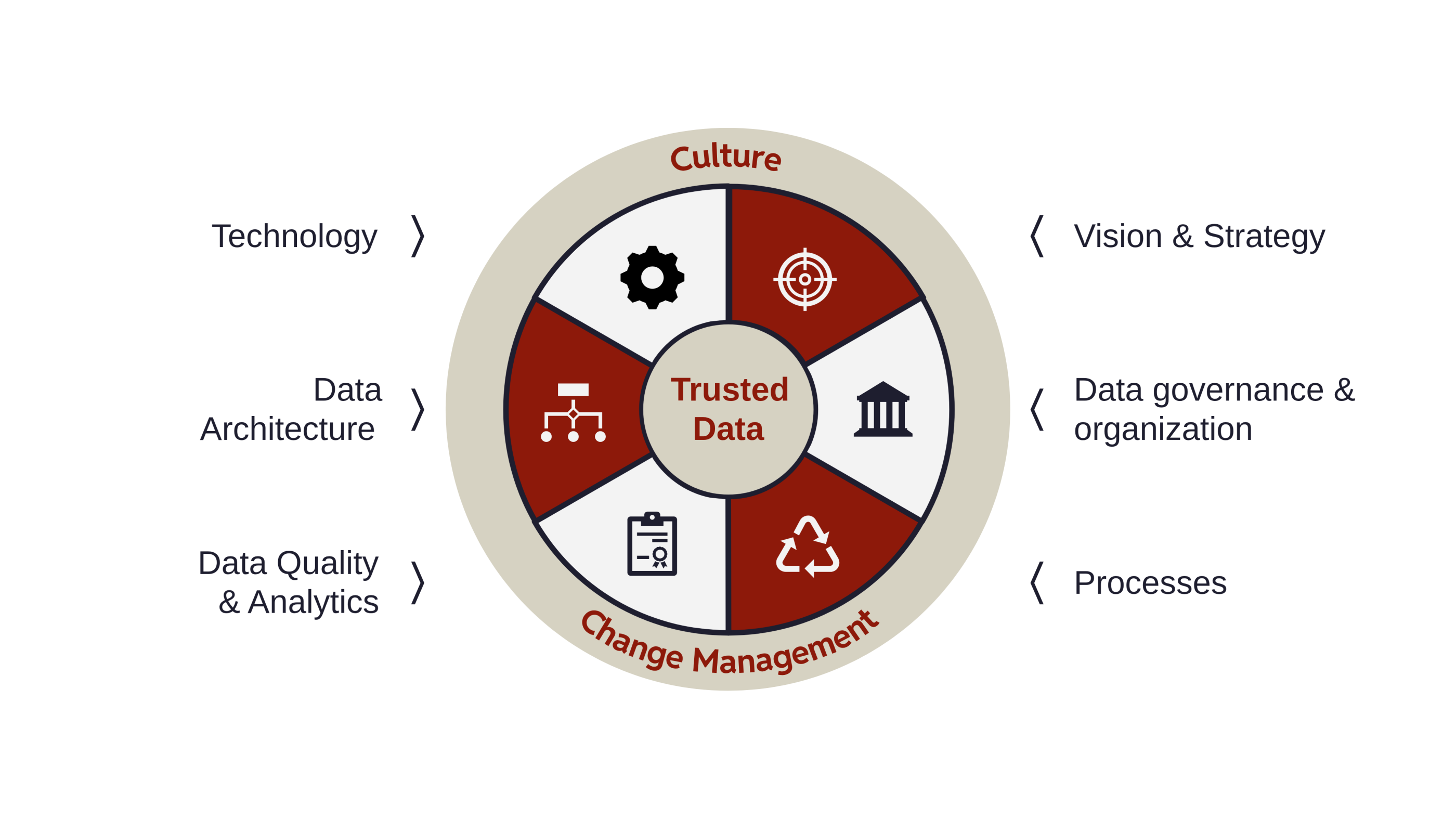
The Squadra framework: trusted data through coherence between strategy, technology, governance, processes, organisation and culture.
The basic idea is the same: an organisation only creates sustainable value with data when it develops concrete applications in conjunction with technology, governance, knowledge, processes and organisation. The way an organisation structures, prioritises and puts these components into practice is always organisation-specific.
Building A Sustainable Data Foundation
KLM Engineering & Maintenance is strengthening four interconnected pillars:
- Technology: an analytics environment that supports the development, use and management of data applications.
- Data governance: clear agreements on ownership, decision-making, data quality, definitions and access.
- Data literacy: the knowledge and capabilities employees need to understand and responsibly apply data.
- Organisation: clear responsibilities and effective collaboration between business, data and technology teams.
Concrete use cases provide direction for the development of these pillars. They show where additional technology, governance, knowledge or organisational agreements are needed. The foundation, in turn, helps to reliably repeat successful applications and deploy them on a larger scale.
In this way, value creation and organisational development reinforce each other. The use cases make the results visible, while the foundation ensures continuity and scalability.
A New Operating Model For Data & AI
The new operating model makes clear where responsibilities lie, how business, data and technology teams collaborate, and how the organisation sets priorities and makes decisions.
Data ownership and governance play an important role in this. Data owners must understand their responsibility, be given sufficient mandate and be able to fall back on workable processes and consultation structures. Simply describing roles and responsibilities is therefore not sufficient.
KLM Engineering & Maintenance is taking a step-by-step approach. The organisation is making roles, decision-making and ways of working more concrete and applying them to practical issues concerning, for example, data quality and KPI definitions. Experiences from practice help to further refine the operating model.
In this way, governance grows from a design on paper into a recognisable part of daily collaboration.
A Roadmap That Provides Direction And Moves With Change
Een integrale roadmap brengt concrete use cases en de ontwikkeling van het datafundament samen. De roadmap geeft richting aan de uitvoering, maakt afhankelijkheden zichtbaar en ondersteunt de prioritering van initiatieven en investeringen.
Door de roadmap jaarlijks bij te stellen en de datavolwassenheid periodiek te meten, kan een organisatie inspelen op veranderende bedrijfsprioriteiten, nieuwe technologische mogelijkheden en lessen uit de uitvoering.
De Data & AI-strategie vormt daarmee geen statisch meerjarenplan, maar een continu proces van kiezen, uitvoeren, leren en bijsturen.
Leadership As A Driving Force
The change affects different parts of the organisation, responsibilities and interests. That is why, in all the programmes we support at Squadra, and also within KLM Engineering & Maintenance, it is necessary to actively involve stakeholders from across the organisation. They bring knowledge from practice, help determine priorities and contribute to a workable setup.
At KLM E&M, senior management demonstrates strong commitment and provides direction for the change. This leadership helps to reinforce responsibilities, establish shared priorities and stimulate collaboration across organisational boundaries.
In this way, the Data & AI strategy develops into a shared organisational task, rather than a programme of data or technology teams alone.
The Result: More Control And Higher Data Maturity
KLM Engineering & Maintenance brings distributed initiatives together in a more manageable and coherent approach. The organisation has:
- a new operating model with clearer responsibilities;
- a roadmap that connects use cases and the development of the foundation;
- clearer principles for data ownership and governance;
- strong commitment and active involvement from senior management;
- a better connection between data investments and business objectives;
- higher data maturity.
KLM Engineering & Maintenance therefore has more than a substantive Data & AI strategy. The organisation is also strengthening its ability to execute this strategy, evaluate results and continuously further develop the approach.
“A data strategy only creates lasting value when an organization develops use cases, technology, governance, knowledge and ownership from one common source.”
The case shows that lasting value with Data & AI does not only arise from choosing the right use cases or technology. Clear ownership, appropriate governance, sufficient knowledge and an organisation that continuously learns and adjusts are at least as important.
The Squadra programme manager shaped and led the programme from the start. Now that the operating model is in place and the new organisation is increasingly fulfilling its role, the programme manager is transferring responsibility. This gives the organisation itself control over the further execution and development of the Data & AI strategy.
Curious how to sustainably embed Data & AI in your organisation?Create clear ownership, connect use cases to a strong data foundation and give your Data & AI strategy the structure it needs to create lasting value.
Discover what a suitable Data & AI operating model can mean for your organisation. Get in touch with us without obligation!